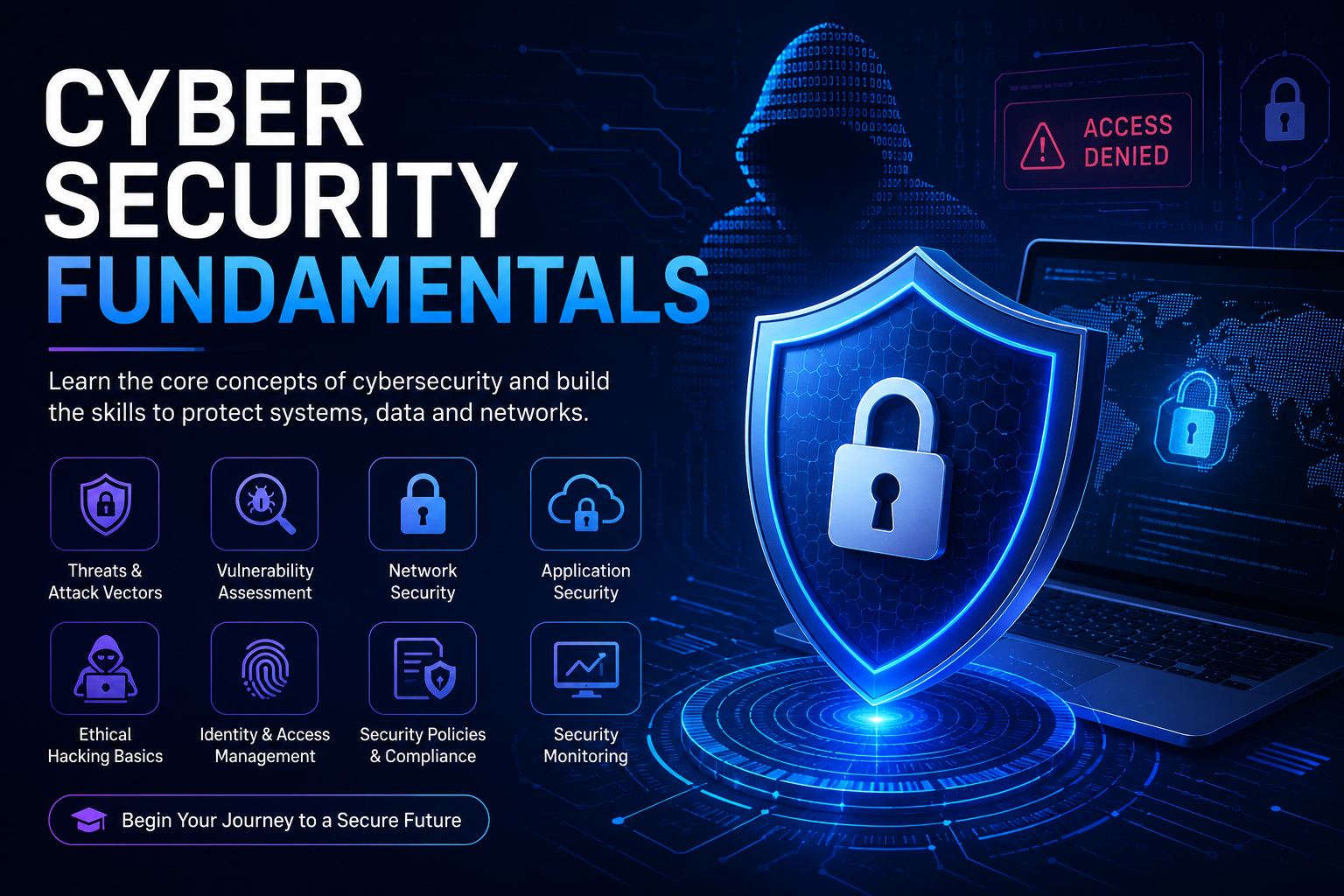
Cyber Security Fundamentals
Build a strong foundation in cyber security by learning how to identify, prevent, and respond to modern cyber threats.
# Cyber Security Fundamentals
## Course Overview
Cyber Security Fundamentals is an introductory course designed for students who want to build a strong foundation in information security. You'll learn how cyber attacks work, how organizations defend against them, and how to identify common security risks.
Through practical demonstrations and hands-on labs, you'll gain the knowledge required to begin your journey toward becoming a cybersecurity professional.
---
## What You Will Learn
- Introduction to Cyber Security
- CIA Triad (Confidentiality, Integrity, Availability)
- Types of Cyber Threats and Attacks
- Malware Analysis Basics
- Phishing & Social Engineering
- Password Security & Multi-Factor Authentication
- Network Security Fundamentals
- Firewalls and VPNs
- Web Application Security Basics
- Cryptography Fundamentals
- Vulnerability Assessment
- Introduction to Ethical Hacking
- Security Policies and Best Practices
- Incident Response Basics
---
## Hands-on Labs
Throughout the course you will complete practical exercises including:
- Identifying phishing emails
- Network scanning using Nmap
- Basic vulnerability scanning
- Password strength analysis
- Wireshark packet analysis
- Linux security commands
- Web security testing using OWASP Juice Shop
---
## Tools You'll Use
- Kali Linux
- Nmap
- Wireshark
- Burp Suite Community
- OWASP Juice Shop
- Metasploit Framework (Introduction)
- OpenVAS
- Linux Terminal
---
## Skills You'll Gain
- Cybersecurity fundamentals
- Threat identification
- Risk assessment
- Network security
- Secure password management
- Ethical hacking basics
- Security awareness
- Incident response
- Security best practices
---
## Prerequisites
No prior cybersecurity experience is required.
Basic computer knowledge and familiarity with Windows or Linux is recommended.
---
## Career Opportunities
After completing this course, learners can pursue roles such as:
- Cyber Security Analyst
- SOC Analyst (Level 1)
- Information Security Associate
- Network Security Administrator
- Vulnerability Assessment Analyst
- IT Security Support
---
## Course Outcome
By the end of this course, students will understand modern cyber threats, implement basic security controls, and perform introductory security assessments using industry-standard tools.